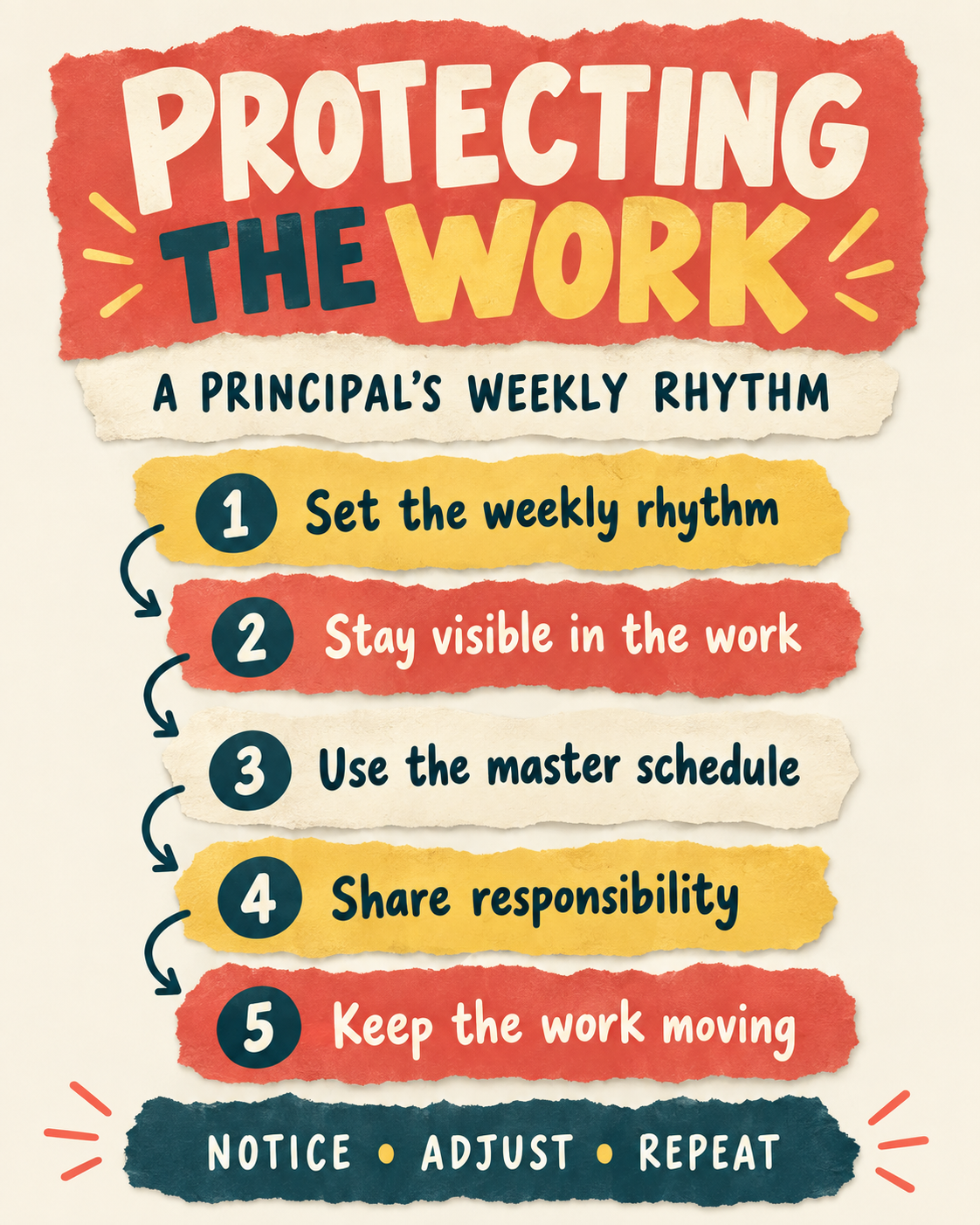
A principal’s calendar fills up quickly. There are meetings to lead, questions to answer, decisions to make, and needs that come up without warning. If I am not intentional about my schedule, the day can become one long response to whatever is loudest or most urgent in the moment.
After seven years as a principal, I’ve learned that protecting the work takes more than managing my own time. It means building systems that help people plan, know where to go, and keep things moving when I can’t respond personally.
For me, it starts with giving recurring work a predictable place.

I give recurring work a home
Mondays are built around MTSS meetings. I use available blocks for ILT, especially when we aren’t meeting with teachers or discussing students. Our committees also meet on Mondays, rotating by tier through the month. For example, Tier 1 meets the first Monday, Tier 2 the second, and Tier 3 the third.
Tuesdays are our ARD scheduling day, and Thursdays are our backup ARD day. That doesn’t mean those days are completely booked. It lets our diagnostician and speech-language pathologist know when they may schedule ARDs with me. Tutoring and extracurricular activities also happen on Tuesdays and Thursdays.
Wednesdays are our PLC day. I also reserve an hour that can be used for faculty meetings. Fridays are more flexible, with recurring time for campus event planning with key staff and an administrative meeting with my assistant principal.
These are the anchors in my week. They give recurring responsibilities a predictable place and help the people I work with plan ahead. The calendar gives us a rhythm, while still leaving room for the needs that come up.
Open time is part of the plan
People may wonder when I get everything else done. I use the open blocks between those commitments for classroom visits, follow-up, planning, conversations, and unexpected needs.
Those blocks also give me flexibility when I need to step away from the campus to meet with my supervisor or handle another responsibility. I prepare staff to help keep things moving when I’m away. The office can reach me when I need to be involved, and the systems we’ve built help identify other staff who may be able to support a need.
An open block is useful because it gives me room to respond and stay connected to the work. I don’t need to fill every hour with a meeting for my calendar to be purposeful.
Walkthroughs matter, and I’m always paying attention
I know one question principals may have is, “When do you conduct walkthroughs?” Walkthroughs are an essential part of instructional leadership, so I make time for classroom visits in the open blocks between my scheduled commitments. Teachers need feedback, and I need to see instruction so I can recognize strengths, understand what students need, and provide support.
My observation and feedback also carry into other parts of the school day. I may provide live coaching in the moment, documented walkthrough feedback, or follow-up in a conversation. In MTSS and ARD meetings, I’m paying attention to whether a teacher knows the student well, comes prepared with data, understands the interventions in place, and has communicated with the family.
Those things matter because teaching is connected to the work we do throughout the day. I’m visible in the walkthroughs I conduct, the decisions I make, the feedback I give, and the way I stay aware of students’ needs—individually and collectively. I’m also coaching and supporting the people I supervise as they grow into stronger administrators.
Classroom walkthroughs remain a key part of how I support instruction. My leadership also means noticing where teachers may need support across the work they do and creating systems that help them be successful.
The master schedule helps us respond as a team
My weekly calendar organizes my responsibilities. The master schedule helps me see how the school day is organized across the building, including where staff may have open blocks. That visibility is useful to my office staff.
If a classroom needs support while I’m unavailable, the schedule can help the office identify someone who may be able to help. We still consider that person’s responsibilities and the students they serve. The schedule gives us a place to look and a possible next step.
That has happened in real time. A teacher needed support, I couldn’t respond right away, and the schedule helped the office identify another staff member who might be available. I want the people around me to have enough information to respond thoughtfully, while keeping me informed when I need to follow up.
Shared work still needs clear accountability
I do not work lunch duty, and I don’t expect my assistant principal to spend the entire lunch period in the cafeteria. Lunch supervision matters, and we organize coverage so students are supervised by the adults assigned to that work. Our playground and traffic monitors, assistant principal, counselor, librarian, and teachers with open blocks may all support those arrangements when their responsibilities allow.
The work of the principal and assistant principal matters too. We need time to support instruction, teachers, and students, and to lead the campus. Sharing duties helps ensure coverage while keeping administrators present for that work.
At the beginning of the school year, I make sure staff understand what they are accountable for during their assigned duty times. If a behavior concern comes up in the cafeteria, I want us to look at what happened around it: How was the space set up? What was the adult’s role? Were students actively monitored? How did the adult respond?
Those questions help us understand what adults can do to prevent concerns, respond to them, and keep students safe. The work is shared, and each person is responsible for carrying out their role well.
Meetings need continuity
A predictable meeting time is helpful. The meeting also needs a system. For ILT, I expect us to continue the work from where we left off the week before. Agendas help us track decisions, questions, and next steps so we can keep moving forward instead of starting over.
When people know what to bring, what we’re working on, and how we’ll follow up, we use our time better. The structure protects the purpose of the meeting and the time of the people in it.
Systems help the work keep moving
My calendar reflects what needs consistent attention: supporting students, developing teachers, keeping communication moving, and protecting time for instruction and leadership. The master schedule helps extend that organization across the building. Together, these systems help people know when work happens, who may be able to help, and what needs to happen next.
The day won’t always go according to plan. A steady rhythm gives us a place to return to and helps the school keep moving when something changes. For me, protecting the work means building a school where important work has a place, people know their roles, and we can respond to students and teachers as a team.
Stay Connected
- Subscribe to The Wildflower Within to receive new posts by email. Be sure to click the confirmation link in your email to complete your subscription.
- Follow on Instagram: @thewildflowerwithin_
- Join the Facebook group: Principal to Principal
- Shop my Teachers Pay Teachers store: The Wildflower Within
Keep Becoming.
Julie | The Wildflower Within 🖤



Leave a Reply